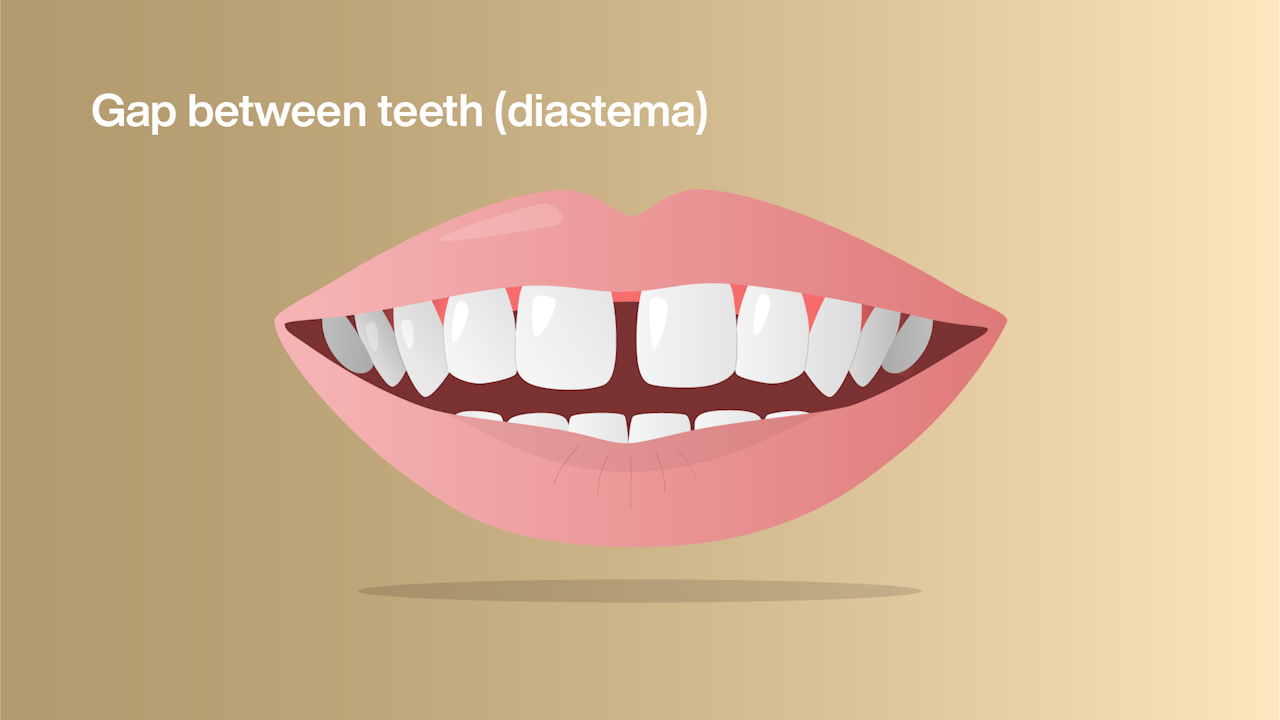
Several options are available for closing a tooth gap. The most suitable method depends heavily on its size and root cause. Depending on these factors, providers may recommend fixed braces, a transparent aligner, composite resin to build up the teeth or ceramic veneers.
While a tooth gap rarely impacts overall health, post-treatment care is vital. “Wearing a retainer is essential after any orthodontic treatment,” emphasises Dr Johner. This thin wire or custom tray prevents the teeth from shifting back towards their original positions and causing the gap to return.
Train track braces
Traditional fixed braces (also known as train track braces) are particularly effective for larger tooth gaps and complex structural misalignments.
Because the brackets are bonded directly to the teeth, they work around the clock. “This approach is often more reliable than clear aligners because patients cannot forget to wear them,” notes Dr Johner. Fixed braces offer precise control over tooth movement, with treatment typically lasting between one and three years, or longer in more complex cases.
Transparent aligners
Clear aligners offer a discreet alternative to traditional braces, making them highly popular with adults.
These transparent trays are ideally suited for treating minor gaps or isolated spaces between the front teeth. In milder cases, small gaps can visibly diminish within just a few months.
However, aligners are rarely recommended for large, multiple gaps or severe misalignments, where fixed braces tend to prove far more effective.
Closing tooth gaps with composite bonding
Minor gaps can often be closed using composite bonding. During this procedure, the dentist applies a tooth-coloured composite resin to the sides of the teeth and shapes it to seamlessly close the space.
Bonding is incredibly conservative because it requires no removal of healthy tooth structure. This fast, cost-effective method is best reserved for small gaps.
Longevity depends on the material used, the patient’s dental care regime and the amount of biting force placed on the resin. In many cases, the composite bonding remains stable for several years.
Veneers
Veneers are custom, wafer-thin ceramic shells that are permanently bonded to the front surface of the teeth. Often dubbed the ‘Hollywood solution’, they offer an exceptionally natural, flawless and aesthetically pleasing correction of small tooth gaps.